
By LIME Logistics · · 8 min read
What makes a load oversize or overweight
In the United States, federal rules set baseline limits for trucks on the Interstate system, and each state adds its own rules for its roads. A load is generally considered oversize when its width exceeds 8.5 feet (102 inches), when its height exceeds the state limit, which is commonly 13.5 feet but varies by state, or when its length exceeds what the state allows for the trailer combination. A load is considered overweight when the gross vehicle weight exceeds 80,000 pounds or when any individual axle or axle group exceeds its legal limit.
Canada has a similar framework managed at the provincial level. In Ontario, for example, the standard legal width is 2.6 metres, and loads beyond the legal dimensions or weights require a permit from the Ministry of Transportation. Every province on a cross-border route has its own permit office and its own conditions.
Loads that are far beyond normal limits are often called superloads. The thresholds differ by jurisdiction, but superloads typically require engineering reviews of bridges, longer permit lead times, and sometimes police escorts or utility crews to lift lines along the route.
How the permit process works
Oversize and overweight permits are issued by each state or province, not by a single national authority. A shipment from Buffalo to Texas may need separate permits from New York, Pennsylvania, and every other state along the way. Each permit specifies the exact route, the dimensions and weight it covers, the dates it is valid, and any conditions such as escort requirements or travel times.
To apply, the carrier or permit service needs accurate information about the load and the equipment: the commodity, its length, width, height, and weight, the truck and trailer configuration, the number of axles, and the axle spacing. Small errors can invalidate a permit, and a load that is stopped at a scale with dimensions that do not match its permit can be held, fined, or turned back.
Routine oversize permits are often issued within a day or two. Larger loads, routes with sensitive bridges, and superloads can take weeks. Building permit time into the project schedule is one of the most important parts of planning a heavy haul move.
Escorts, signage, and route surveys
Once a load passes certain width, height, or length thresholds, states require pilot cars, also called escort vehicles. One escort may be required in front or behind for moderately wide loads, while wider or taller loads may need escorts in both positions. Very tall loads may need a height pole on the lead car to confirm clearance under bridges and signals.
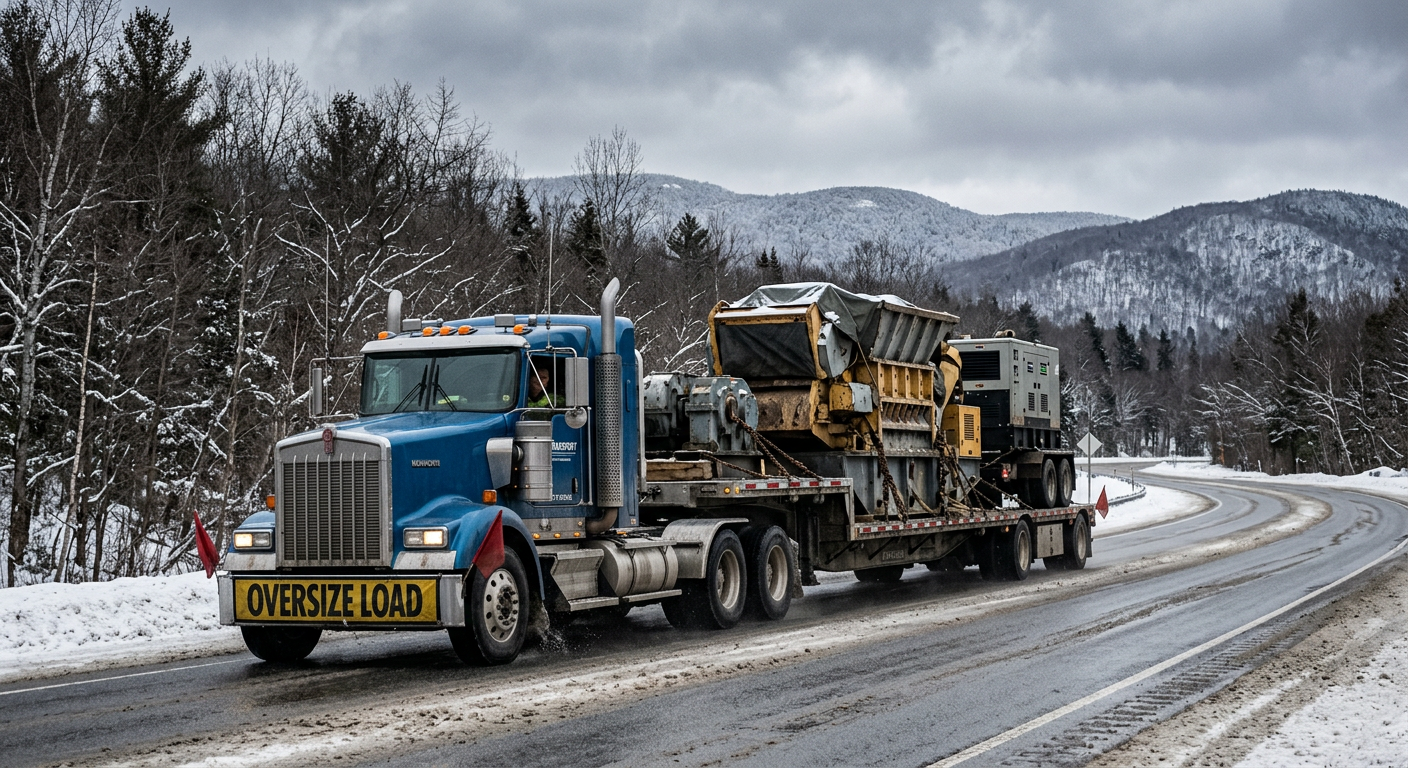
Every oversize load must also display the required signage and flags. That usually means "Oversize Load" banners on the front and rear and red or fluorescent flags at the extremities of the load. Many states also require amber warning lights for loads moving at certain widths.
For the largest moves, a route survey is completed before the permit is issued. A surveyor drives the route ahead of time, measures clearances, checks turning radii, and notes construction zones. This step prevents the worst-case scenario of a load stuck under an overpass or unable to make a turn.
Travel restrictions to plan around
Permitted loads usually cannot move whenever the driver wants. Common restrictions limit oversize movement to daylight hours, often from 30 minutes before sunrise to 30 minutes after sunset. Many states restrict or prohibit oversize travel on weekends and major holidays, and urban areas may block movement during rush hours.
Weather also plays a role. High winds, ice, snow, and poor visibility can stop a permitted load until conditions improve. In the Northeast and Canada, spring thaw restrictions can reduce allowable axle weights on some roads for several weeks each year. These rules make transit times for heavy haul less predictable than standard truckload, so planning buffer days into delivery schedules is essential.
Choosing the right trailer
The trailer you choose directly affects whether a load is legal and how many permits it needs. A load that is over height on a standard flatbed may be perfectly legal on a trailer with a lower deck. Matching the trailer to the freight is often the cheapest way to simplify a heavy haul move.
- Flatbed: a standard deck height of about 5 feet. Good for freight that is wide or long but not tall.
- Step deck (drop deck): a lower rear deck, usually about 3.5 feet high, allowing taller freight to stay under height limits.
- RGN (removable gooseneck): the front detaches so equipment can drive onto a low deck. Ideal for tracked and wheeled machinery like excavators and dozers.
- Lowboy: a very low deck for very tall or heavy equipment. Often configured with extra axles to spread weight.
- Stretch and extendable trailers: for long items such as beams, poles, and wind components.
- Multi-axle and specialized heavy haul configurations: used when a load is so heavy that weight must be spread across many axles to meet bridge and road limits.
Securement and loading
Heavy and oversize loads must be secured according to federal cargo securement rules in the US and the national safety code standards in Canada. That means the right number and rating of chains, binders, and straps, along with blocking and bracing where needed. Machinery often has specific securement requirements, and loose attachments must be secured separately.
Loading and unloading also need planning. Some equipment can be driven on and off a trailer, while other freight needs cranes, forklifts, or rigging crews at each end. Confirming who provides that equipment, and when it will be available, prevents costly detention and rescheduling.
Information to have ready when you request a quote
Heavy haul quotes are only as accurate as the information they are based on. Before you call, gather the following details so the carrier can pick the right equipment and estimate permit and escort costs correctly.
- Commodity and model number, with a spec sheet or photos if possible
- Exact length, width, height, and weight, including any attachments
- Pickup and delivery addresses and site conditions, such as dock, ground level, or job site access
- Loading and unloading method, and who supplies cranes or forklifts
- Required pickup and delivery dates and any hard deadlines
- Whether the load crosses the US-Canada border
Moving oversize freight across the US-Canada border
Cross-border heavy haul adds another layer of coordination. The load needs permits from every state on the US side and every province on the Canadian side, and the permit dates must line up with the expected crossing time. If customs clearance is delayed, a permit can expire before the truck is released, forcing a new application.
Customs documentation also has to describe the equipment accurately, including serial numbers for machinery. Many heavy haul loads are temporary imports, such as equipment going to a job site and coming back, which may qualify for special customs treatment. Working with customs brokers on both sides early in the process keeps the border from becoming the bottleneck.
Some border crossings have restrictions on oversize loads or limited hours for permitted freight, so the crossing point should be part of route planning rather than an afterthought.
Heavy haul with LIME Logistics
LIME Logistics arranges step deck, over-dimensional, RGN, and lowboy moves across the United States and Canada. We coordinate permits, escorts, and route planning with experienced specialized carriers, and we keep you updated as the load moves through each jurisdiction.
Our Buffalo location gives us regular experience with heavy equipment crossing between New York and Ontario, where permits, customs, and border scheduling all have to line up. Whether you are moving a single machine to a job site or a series of oversize components to a plant, we will help you choose the right equipment and build a realistic schedule.
Frequently asked questions
How wide can a load be without a permit?
In most of the United States, the legal width is 8.5 feet (102 inches). Anything wider generally requires an oversize permit from each state on the route.
When does a load need a pilot car?
It depends on the state and the load dimensions. Many states require at least one escort once a load passes roughly 12 feet wide, with more escorts for wider, taller, or longer loads.
What is the difference between an RGN and a lowboy?
An RGN is a type of lowboy with a removable gooseneck, so equipment can be driven onto the deck from the front. A fixed-neck lowboy is loaded from the rear or with a crane.
- Heavy haul
- Specialized
- Permits